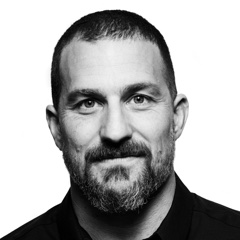
Andrew Huberman
neuroscientist, professor at Stanford · Huberman Lab · 7.64 million subscribers
Book: Protocols (2025)
podcast · Spotify · YouTube · hubermanlab.com · Wikipedia
Huberman's convictions
Huberman is outspoken about lifestyle habits that affect the brain, the nervous system and physical fitness. The common thread running through his views: daily behaviour has direct, measurable effects on the brain and hormonal balance. For instance, citing research, he argues that consciously extending your exhale lowers heart rate and primes the nervous system for sleep. Morning sunlight, he says, regulates the cortisol peak and thereby improves both alertness and sleep quality at night. And Non-Sleep Deep Rest, his own term for deep rest without actually sleeping, could raise baseline dopamine levels in the brain by around sixty percent. Sunlight on the skin and in the eyes matters to Huberman not just for vitamin D, but for the broader functioning of cells. He also considers mineral sunscreen based on zinc oxide preferable to chemical alternatives. For this last point he offers no concrete substantiation.
When it comes to training and behaviour, Huberman invariably draws on studies. Weekly strength training, he claims, is comparable to or more effective than certain antidepressants for mental health, pointing to "great data emerging." He describes strength and cardiovascular training together as essential for longevity and wellbeing. Particularly striking is his claim about the anterior mid-cingulate cortex: doing tasks you would rather avoid demonstrably enlarges this brain region and strengthens willpower in other areas.
On supplements and medication, Huberman himself draws distinctions in the quality of evidence. He backs alpha-GPC for focus, alpha-lipoic acid for loss of smell and a low dose of tadalafil for men over forty with studies, though he acknowledges in the case of alpha-lipoic acid that it involves a "small amount of data." His rejection of vegetable seed oils, by contrast, rests entirely on personal preference and experience: "I'm not aware of any randomized control trial that says that they're bad." That is a notable exception in a pattern that otherwise leans heavily on published research. He expresses concern about the risks of cannabis for people with a genetic predisposition to psychosis, but without citing an explicit source.
How well does Huberman actually back up his claims? Of the 23 positions we recorded, he cites research for eighteen and gives no basis for three. It is also possible to verify: on his own website, almost every episode is accompanied by a list of the publications referenced, in seven of the eight episodes we examined.
Based on 255 episodes (469 hours)
| own podcast, since 2024-01-01 | 249 episodes (451 hours) |
| long conversations elsewhere | 6 (18 hours) |
| claims tested | 15 |
This page lists only Huberman's own claims; what guests claimed on the show is on the podcast page. All tested claims from Huberman Lab →
Interventions and supplements
For: Men over forty should consider taking a low daily dose of tadalafil for prostate health and circulation.
“low dose like 2.5 to 5 milligrams per day is very helpful for perfusion of the prostate and also it causes vasodilation in the brain” · 00:00:22 · Modern Wisdom · 2026-05-25 · 162 min
based on: a study
For: Alpha-lipoic acid may help restore the sense of smell following a viral infection.
“There are good data, in my opinion, small amount of data, but let's call it decent enough data to explore, that alpha-lipoic acid at 600 milligrams per day during the time when you starting to lose your smell, might rescue some of that smell.” · 20:00:00 · Joe Rogan · 2024-08-27 · 193 min
based on: a study
For: Alpha-GPC is an effective supplement for boosting alertness and focus.
“600 milligrams of Alpha-GPC is going to make you more alert. Is it safe? Right. Right. And so they exist, and and certainly that's one that I would put kind of high on the tier of things for if you want alertness and focus” · 71:15:00 · Joe Rogan · 2024-08-27 · 193 min
based on: a study
For: Cold water exposure is an effective way to wake up faster and become more alert, driven by a rise in core body temperature and adrenaline.
“So why do you wake up more quickly in the cold? Well, body temperature goes up more quickly, also big shot of adrenaline from cold water. Nobody escapes the adrenaline from cold water.” · 74:11:00 · Joe Rogan · 2024-08-27 · 193 min
based on: a study
For: MDMA-assisted therapy is an extremely valuable and effective treatment for PTSD when proper safety measures are in place.
“I think it's unfortunate given the really strong data that support the use of MDMA for the treatment of PTSD. I mean, more than 60% you know successful, in air quotes, plus some people just go into total remission, but the hazards are there” · 109:20:00 · Joe Rogan · 2024-08-27 · 193 min
based on: a study
Brain and memory
Mixed: Cannabis use carries real risks of triggering lasting psychosis in people with a genetic predisposition.
“Other people who have a predisposition to psychosis, like they can end up with some permanent psychosis.” · 01:17:33 · Modern Wisdom · 2026-05-25 · 162 min
based on: no basis given
For: Delayed gratification and self-control are measurable traits that can be trained and developed throughout life.
“it turns out that this self-control, delayed gratification thing does seem to hold up over time. You can, but you can build it out. You can develop this.” · 02:27:43 · Modern Wisdom · 2026-05-25 · 162 min
based on: a study
For: Targeted smell training using strong scents supports the recovery and preservation of olfactory neurons.
“It is true that the behavioral tool of taking a lemon and really just like getting it close to that nostril and just really trying to get whatever little whiff of lemon you can, and then taking, you know, your coffee and getting that little whiff of coffee... has been shown to improve the survival and eventually the durability of not just the olfactory neurons, but scent.” · 21:20:00 · Joe Rogan · 2024-08-27 · 193 min
based on: a study
For: Doing difficult tasks you would rather avoid enlarges the anterior mid-cingulate cortex and builds perseverance.
“If you really don't want to do something, and you do it, this area gets bigger. And it's got inputs and outputs from all of these different brain areas that make all of this make sense... and the best part is it translates to an ability to do harder things elsewhere.” · 79:06:00 · Joe Rogan · 2024-08-27 · 193 min
based on: a study
For: Anyone can rewire their brain at any age, learn new skills and overcome trauma.
“if the question is, can a person change, can you learn new thing, can you unlearn certain patterns, can you overcome traumas at any age, the answer is absolutely, categorically, yes.” · 00:43:42 · Diary of a CEO · 2024-08-29 · 240 min
based on: a study
Against: Chasing dopamine peaks that are achieved easily and without meaningful effort leads to addiction and burnout.
“any behavior, any substance that stimulates a lot of dopamine and that is easily accessed without effort is potentially problematic.” · 01:49:14 · Diary of a CEO · 2024-08-29 · 240 min
based on: a study
For: Non-Sleep Deep Rest (NSDR) and Yoga Nidra are effective tools for restoring baseline dopamine levels in the brain and compensating for sleep deprivation.
“NSDR, non-sleep deep rest, aka Yoga Nidra, can increase the baseline levels of dopamine in a brain area called the basal ganglia... by about 60% from baseline” · 01:11:15 · Diary of a CEO · 2024-08-29 · 240 min
based on: a study
Sleep
For: Deliberately extending your exhales is an effective way to lower your heart rate and calm your nervous system before sleep.
“when you deliberately exhale, you slow your heart rate down. You want your heart rate pretty low before bed.” · 01:40:24 · Modern Wisdom · 2026-05-25 · 162 min
based on: a study
For: Exposure to natural morning sunlight is crucial for a healthy cortisol peak, greater alertness during the day and better sleep at night.
“We know that bright light in the morning, especially from sunlight, increases daytime mood, focus, and alertness, and it will improve your sleep later that night.” · 01:05:36 · Diary of a CEO · 2024-08-29 · 240 min
based on: a study
Against: Not everyone needs eight or nine hours of sleep per night; individual sleep needs vary.
“I'd like to dispel the myth, even though my friend Matt Walker will probably get upset at me for saying this, not everyone needs eight or nine hours of sleep.” · 01:00:18 · Diary of a CEO · 2024-08-29 · 240 min
based on: personal experience
Skin
For: Direct exposure to sunlight on the skin and in the eyes is essential for overall health and cellular function.
“You need sunlight. Not just for vitamin D. You want sunlight on your skin as much as possible in terms of days of your life that you can get it” · 01:51:59 · Modern Wisdom · 2026-05-25 · 162 min
based on: a study
For: Mineral-based sunscreens such as zinc oxide are preferable to chemical sunscreens.
“just use a mineral-based sunscreen, mineral only, so zinc oxide only.” · 01:54:36 · Modern Wisdom · 2026-05-25 · 162 min
based on: no basis given
Muscles and exercise
For: Training the neck muscles is crucial for upper back stability and shoulder girdle support.
“You got to train your neck, guys. You got to train your neck.” · 02:05:00 · Modern Wisdom · 2026-05-25 · 162 min
based on: no basis given
For: Strength training has a powerful positive effect on mental health that is comparable to or greater than that of antidepressants.
“And I also think there's great data emerging that they transform mental health. I mean, the data on resistance training two or three times a week and mental health is striking. I mean, you compare that to what people get from certain SSRIs, and you're like for goodness sake, 45, 60 minutes a week, lift some heavy objects.” · 108:24:00 · Joe Rogan · 2024-08-27 · 193 min
based on: a study
For: Everyone should do both strength training and cardiovascular training every week to promote brain health and longevity.
“everybody, for sake of longevity and immediate what I guess what we call healthspan and lifespan and well-being, for that matter, should be doing at least two or three days per week of resistance training of some sort... and cardiovascular training.” · 01:11:02 · Diary of a CEO · 2024-08-29 · 240 min
based on: a study
Nutrition and prevention
Against: Seed oils should be avoided in favour of olive oil, butter and animal fats.
“I don't like seed oils, I don't eat them, but I'm not aware of any randomized control trial that says that they're bad. I just don't like them. I like olive oil and butter, and I like cooking cooking beef and beef fat. Tastes better, and I feel better.” · 105:14:00 · Joe Rogan · 2024-08-27 · 193 min
based on: personal experience
For: Eating mainly whole, unprocessed foods reprogrammes the neural associations between taste, calories and nutritional value, and reduces unhealthy cravings.
“I think that we can rewire, in fact, we know that you can rewire your association between nutritive value, taste of food, calories, and micronutrients.” · 01:18:22 · Diary of a CEO · 2024-08-29 · 240 min
based on: a study
Hormones and reproduction
Against: Men who are trying to conceive should avoid heat exposure such as saunas and hot baths, as this lowers viable sperm count.
“if you go into a sauna or a hot tub or a hot bath, you will lower the number of viable sperm that you produce in over the course of the next 60 to 90 days.” · 01:37:53 · Diary of a CEO · 2024-08-29 · 240 min
based on: a study
Commercial partners
Commercial partners are listed in 244 of the 249 episodes since 2024-01-01.
AG1, LMNT, FUNCTION, EIGHTSLEEP, BETTERHELP, DAVIDPROTEIN, SLEEP, JOOVV